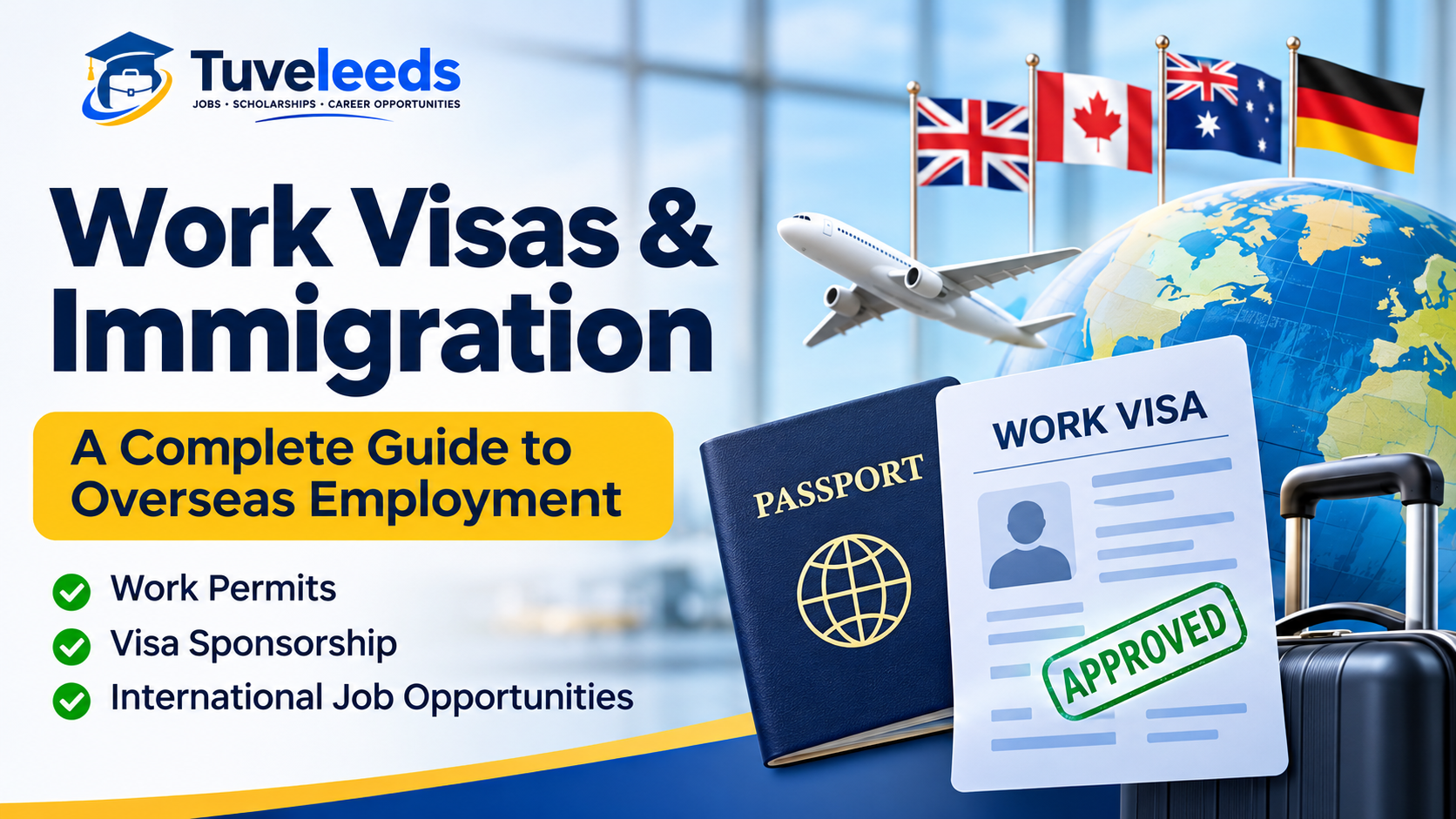
Working abroad can be an excellent opportunity to develop your career, gain international experience, and improve your financial future. Many professionals from Pakistan and other countries look for overseas jobs that offer better salaries, career growth, and opportunities to relocate with their families.
However, finding a job abroad involves more than submitting a CV and receiving an offer letter. You must understand the destination country's immigration rules, work visa requirements, employer sponsorship procedures, and employment regulations before accepting an international job offer.
This guide explains how work visas, work permits, and visa sponsorship work, how to find legitimate overseas employment, and what you should know before moving to another country for work.
What is a work visa?
A work visa is an immigration authorization that allows a foreign national to enter or remain in a country for employment, subject to the conditions of the visa.
Depending on the country and visa category, a work visa may allow you to:
- Work for a specific employer or an eligible range of employers.
- Stay in the country for a specified period.
- Renew your employment authorization when eligible.
- Bring eligible family members to live with you.
- Apply for permanent residence through an eligible immigration pathway.
A work visa does not automatically give you permission to work for every employer. Some visas are tied to a particular company, while others provide more flexibility.
For example, entering a country on a visitor visa generally does not allow you to start regular employment. You must obtain the appropriate work authorization before beginning work.
What is a work permit?
A work permit is an authorization issued by a government that allows a foreign national to perform employment under specified conditions.
In some countries, a work permit and a work visa are separate documents. In others, employment authorization is included in a combined visa or residence permit.
For example, Canada offers employer-specific work permits and open work permits for eligible applicants. An employer-specific permit generally identifies the employer and may include restrictions relating to the occupation or location of employment.
An open work permit may allow an eligible person to work for different employers, but it is only available to people who meet specific immigration requirements.
Before applying for an overseas job, check the official immigration website of your intended destination to understand which type of authorization you need.
Work visa vs. work permit
- Work visa: Immigration authorization to enter or remain in a country for employment.
- Work permit: Legal authorization to perform employment under specified conditions.
- Residence permit: Authorization to reside in a country, sometimes combined with permission to work.
- Employment contract: An agreement between an employer and employee that explains the terms and conditions of employment.
- Visa sponsorship: An employer's role in supporting a foreign worker's immigration application under the relevant immigration system.
These terms can have different meanings in different countries. Always confirm the requirements for your specific visa category rather than relying on general information.
What is visa sponsorship?
Visa sponsorship generally refers to an employer supporting a foreign worker's application for legal employment in another country.
In many immigration systems, an employer must obtain approval before hiring a worker from overseas. This may involve demonstrating that the company is eligible to employ foreign workers, that the position meets the immigration requirements, and that the proposed employee satisfies the relevant criteria.
Depending on the country, an employer's responsibilities may include:
- Obtaining an employer sponsorship licence or approval.
- Providing a genuine job offer and employment contract.
- Obtaining approval for the position where required.
- Providing sponsorship documentation.
- Submitting information about the job, salary, and employee.
- Paying applicable employer-side immigration charges.
- Complying with employment and immigration regulations.
The employee may then need to submit a separate visa or work permit application.
Visa sponsorship does not guarantee that an immigration application will be approved. The applicant must still meet the eligibility requirements and provide the necessary documents.
For example, the United Kingdom's Skilled Worker route generally requires an eligible job offer from an approved sponsor, an eligible occupation, and a salary that meets the applicable requirements.
Types of work visas and employment authorization
There are several types of work authorization available internationally. The appropriate route depends on your profession, qualifications, experience, and intended destination.
1. Employer-sponsored work visas
Employer-sponsored visas are among the most common routes for professionals seeking overseas employment.
Under this arrangement, a company offers a job to a foreign candidate and completes the required sponsorship procedures.
These visas are commonly used for software developers, engineers, healthcare professionals, finance specialists, project managers, skilled tradespeople, and other eligible occupations.
Some employer-sponsored visas are temporary, while others may provide a pathway to permanent residence if the applicant meets additional requirements.
2. Skilled worker visas
Skilled worker visas are designed for people who have the qualifications, experience, or skills required by the destination country's labour market.
Depending on the immigration system, applicants may need:
- A qualifying job offer.
- Relevant qualifications or professional experience.
- A minimum salary.
- English or another language proficiency.
- Professional registration or licensing.
- Employer sponsorship.
Skilled worker routes are available in several countries, but eligibility criteria and application procedures differ significantly.
3. Temporary work visas
Temporary work visas allow foreign nationals to work for a limited period.
These visas may be available for seasonal employment, temporary projects, agricultural work, hospitality, specialist assignments, or other approved employment categories.
Before accepting a temporary job, check the visa's duration, renewal conditions, and restrictions. Some temporary visas do not allow you to change employers or remain in the country after your employment ends.
4. Open work permits
An open work permit generally allows an eligible individual to work for different employers without obtaining a new employer-specific permit for each job.
However, open work permits are not available to everyone. They are usually restricted to particular immigration categories or personal circumstances.
Applicants should not assume that they can obtain an open work permit simply by applying from overseas.
5. Intra-company transfer visas
Some countries provide immigration routes for employees who are transferred from an international company's office in one country to a branch, subsidiary, or affiliated company in another country.
These routes may be suitable for managers, senior executives, specialized technical employees, and workers with company-specific knowledge.
The employee must meet the relevant eligibility conditions, and the transfer must be genuine.
How to find visa-sponsored jobs abroad
Finding a legitimate employer is often one of the most important steps in the overseas employment process.
Many job seekers search online using terms such as "visa sponsorship jobs," "work visa jobs," or "jobs abroad for Pakistani applicants." However, not every international vacancy offers sponsorship. Some employers only accept candidates who already have permission to work in their country.
Step 1: Identify your target country
Start by researching countries that recruit workers in your profession.
Consider the following factors:
- Demand for your occupation.
- Expected salary and living expenses.
- Language requirements.
- Visa eligibility.
- Family relocation options.
- Long-term career opportunities.
Do not choose a country based only on social media posts or claims of unusually high salaries. Research the actual employment opportunities and immigration requirements.
Step 2: Search for suitable vacancies
Use established job platforms and official recruitment sources to search for international employment.
- LinkedIn Jobs
- Indeed
- Glassdoor
- EURES – European Job Mobility Portal
- Canada Job Bank
- UK Government – Find a job
- Overseas Employment Corporation Pakistan
When searching, use specific keywords such as:
- Visa sponsorship available.
- International applicants welcome.
- Work permit support.
- Employer-sponsored employment.
- Relocation assistance.
- Skilled worker sponsorship.
These phrases can help you find relevant vacancies, but they are not proof that a company can legally sponsor you.
Step 3: Check the employer
Before applying, verify that the company is genuine.
Check its official website, business information, recruitment email address, and professional presence. If the country maintains an official list of approved sponsors, check whether the employer appears on that list.
For example, the UK Government provides a register of licensed sponsors. Applicants can use it to check whether a company is authorized to sponsor workers under the relevant immigration route.
Step 4: Apply with a professional CV
Your CV should clearly explain your education, professional experience, technical and transferable skills, achievements, certifications, and language abilities.
Use a CV format appropriate for the destination country and occupation.
For technical roles, include relevant projects and measurable achievements. For management roles, highlight leadership, budgeting, project delivery, and business results.
Step 5: Confirm sponsorship before accepting the offer
If you receive a job offer, ask the employer whether they will support the required work authorization.
Confirm which visa or work permit route will be used, whether the company is an approved sponsor where required, who will submit the employer-side application, and which costs you will need to pay.
Also confirm whether the job offer is conditional on visa approval.
A genuine employer should be able to explain the recruitment and immigration process clearly.
Documents commonly required for work visa applications
The documents required for an overseas work visa depend on the destination country and the type of employment.
However, many applications require some combination of the following documents.
Personal documents
- Valid passport.
- National identity card.
- Recent passport-sized photographs.
- Birth certificate, where required.
- Marriage certificate, if applicable.
- Police clearance certificate, where required.
Employment documents
- Job offer letter.
- Employment contract.
- Employer sponsorship documents.
- Work permit approval, if applicable.
- Salary and job description details.
Educational and professional documents
- Educational certificates.
- Academic transcripts.
- Professional licences.
- Training certificates.
- Experience letters.
- Updated CV or résumé.
Financial and supporting documents
Depending on the visa category, applicants may also need to provide proof of funds, accommodation arrangements, medical examination results, or health insurance.
Some documents may require translation, attestation, or verification.
Always check the official immigration checklist for your specific visa category. Do not rely on a generic checklist as a guarantee of eligibility.
Work visa opportunities in popular destinations
Different countries have different immigration systems. The following examples explain how employer-sponsored employment may work in several popular destinations.
These are general overviews, not guarantees of eligibility or current job availability.
United Kingdom
The UK's Skilled Worker route allows eligible overseas workers to take up qualifying employment with an approved sponsor.
Applicants generally need a job offer from an approved employer, an eligible occupation, a Certificate of Sponsorship, a salary meeting the applicable threshold, and the required English language proficiency.
The rules for eligible occupations, salary thresholds, and sponsorship can change. Applicants should review the current requirements before applying.
Official information: UK Skilled Worker visa.
Canada
Canada offers employer-specific work permits and open work permits for eligible applicants.
For many employer-specific applications, the employer must obtain a Labour Market Impact Assessment (LMIA), unless the job is exempt.
An LMIA is used to assess whether hiring a foreign worker is justified under the relevant employment program.
Applicants should confirm the required permit category, employer documentation, and eligibility conditions before submitting an application.
Official information: Government of Canada – Employer-specific work permits.
Australia
Australia has several skilled employment visa options, including employer-sponsored pathways.
Depending on the visa category, the employer may need to become an approved sponsor and nominate an eligible worker for an approved position.
Applicants may need to meet occupation, qualification, salary, English language, and other requirements.
Official information: Australian Government – Sponsoring workers.
Germany
Germany offers immigration routes for qualified professionals who meet the relevant employment and qualification requirements.
A genuine job offer, recognized qualifications where required, and compliance with the applicable residence and employment rules may be necessary.
Applicants should research the relevant visa category and confirm whether their qualifications need recognition before applying.
Official information: Make it in Germany – Official information for skilled workers.
United Arab Emirates
The UAE is a popular destination for international workers in industries such as information technology, engineering, healthcare, finance, hospitality, and construction.
The employment process generally involves a formal job offer, an employment contract, work authorization, and the appropriate residence or employment visa procedures.
Applicants should carefully review the terms of the employment contract, including salary, working hours, accommodation, insurance, and other benefits.
Official information: UAE Government – Employment and work permits.
Saudi Arabia
Saudi Arabia is a major destination for international workers in sectors such as construction, healthcare, engineering, hospitality, logistics, and information technology.
Foreign workers must follow the applicable employment and work visa procedures.
Before accepting an offer, verify the employer, employment contract, salary, job title, and any required professional licensing.
Applicants departing from Pakistan should also complete the applicable overseas employment clearance requirements.
Overseas employment requirements for Pakistani citizens
Pakistani citizens planning to work abroad should understand both the destination country's immigration requirements and Pakistan's overseas employment procedures.
The Bureau of Emigration and Overseas Employment (BEOE) regulates overseas employment processes in Pakistan.
Pakistani workers may obtain foreign employment through:
- Direct recruitment by an overseas employer.
- Licensed Overseas Employment Promoters.
- The Overseas Employment Corporation.
- Other legitimate recruitment channels.
The Ministry of Overseas Pakistanis and Human Resource Development provides information about overseas employment and the relevant registration procedures.
What is Protector of Emigrants registration?
Protector of Emigrants registration, commonly referred to as Protector or emigration clearance, is an important legal requirement for Pakistani citizens proceeding abroad for employment.
The process helps register overseas employment and provides a framework for protecting workers' employment rights.
Depending on the applicable procedure, workers may need to submit their passport, identity documents, employment contract, and other required paperwork.
Applicants should confirm the latest requirements and fees through the official BEOE website or the relevant Protectorate of Emigrants office.
Official information: Bureau of Emigration and Overseas Employment.
Why should Pakistani workers complete the Protector process?
Completing the applicable emigration clearance process helps ensure that the worker's overseas employment is properly documented.
It also helps workers understand their employment contract and access the relevant support mechanisms.
Do not travel for overseas employment without checking whether Protector registration or other clearance is required for your situation.
How much does it cost to get a work visa?
The cost of obtaining a work visa varies considerably by country, visa category, and personal circumstances. There is no single fee that applies to every overseas job seeker.
Possible expenses include:
- Visa application fees.
- Work permit fees.
- Passport renewal.
- Medical examinations.
- Police clearance certificates.
- Educational document attestation.
- Translation services.
- Travel expenses.
- Initial accommodation.
- Proof of funds, where required.
Some costs may be paid by the employer, while others may be the responsibility of the applicant.
Before accepting a job offer, request a written breakdown of the expenses.
Be especially careful if a recruiter demands a large advance payment for a guaranteed visa or job. A legitimate employment opportunity should have a verifiable employer, a clear recruitment process, and proper documentation.
How to avoid overseas employment scams
Unfortunately, some individuals and organizations exploit people who want to work abroad.
They may advertise fake jobs, promise guaranteed visas, or demand money for employment opportunities that do not exist.
Understanding the warning signs can help you protect your money, personal information, and future career.
Common warning signs
- Guaranteed visa approval: No recruiter or private agent can guarantee that a government will approve your visa.
- Large upfront payments: Be cautious when someone demands substantial payment before providing a verifiable job offer or explaining the legal recruitment process.
- Fake offer letters: Some scammers use company logos, copied signatures, and fake employment contracts to make their offers appear genuine.
- Requests for sensitive information: Do not share your passport details, bank information, or personal documents with an unverified recruiter.
- Pressure to act immediately: Scammers often create urgency by claiming that a job or visa slot will disappear unless you pay immediately.
- Tourist visa employment promises: Be cautious if someone tells you to travel on a visitor visa and start working without obtaining the required work authorization.
How to protect yourself
- Verify the employer through official sources.
- Check the recruiter's licence where applicable.
- Confirm that the job exists.
- Review the employment contract carefully.
- Use official immigration websites.
- Keep receipts for any legitimate payments.
- Never falsify documents or provide false information in a visa application.
If you suspect fraud, report it to the appropriate authorities in your country.
What should you check before accepting an overseas job?
Receiving a job offer is an exciting milestone, but it is important to review the terms carefully before making a decision.
Salary and benefits
Confirm your gross salary, expected take-home pay, overtime arrangements, and payment schedule.
Accommodation and transport
Some employers provide accommodation or transport, while others do not. Ask whether these benefits are included in your contract.
Medical insurance
Confirm whether the employer provides health insurance and whether your family members will also be covered.
Working hours and leave
Understand the expected working hours, weekly rest days, annual leave, and overtime policies.
Contract duration
Check whether the job is permanent, temporary, or project-based.
Visa and relocation support
Ask whether the employer will cover visa expenses, relocation costs, and initial accommodation.
Family relocation
If you plan to move with your spouse or children, confirm whether the visa category permits dependants and whether additional income or financial requirements apply.
Can you bring your family on a work visa?
Some work visa categories allow eligible workers to bring their spouse and dependent children.
However, family relocation rules vary significantly by country and visa category.
Depending on the destination, family members may be able to:
- Live with the main applicant.
- Attend school.
- Access certain healthcare services.
- Apply for permission to work, where eligible.
Some immigration routes have salary thresholds, financial requirements, or restrictions on family members.
Before accepting a job abroad, check whether your intended visa category allows dependants and whether your employer offers family relocation support.
If you are planning to move with your family, consider the total cost of housing, education, healthcare, and daily living expenses.
How to improve your chances of getting a visa-sponsored job
Competition for international jobs can be high, especially for positions that offer relocation support.
The following steps can help you prepare a stronger application.
Develop in-demand skills
Research the skills and qualifications required in your target country.
For example, IT professionals may benefit from developing skills in software engineering, cloud computing, cybersecurity, data analytics, or project management.
Healthcare professionals may need recognized qualifications, language proficiency, and professional registration.
Gain relevant experience
Employers often prefer candidates who can demonstrate practical experience and measurable achievements.
Document your responsibilities, projects, certifications, and professional accomplishments.
Improve your language skills
English proficiency is important for many international positions. Some countries may also require knowledge of the local language.
Improving your communication skills can help you perform better in interviews and workplace environments.
Build a professional online presence
Maintain an updated LinkedIn profile and professional CV.
Showcase relevant projects, certifications, and experience to help employers understand your professional background.
Apply consistently
International recruitment can take time. Keep applying to suitable vacancies, follow up professionally, and maintain a record of your applications.
Avoid applying indiscriminately to jobs that do not match your qualifications or work authorization eligibility.
Frequently asked questions about work visas and immigration
Can I get a work visa without a job offer?
Some immigration routes allow eligible applicants to apply without a job offer. However, many employer-sponsored work visas require a confirmed employment offer.
The available options depend on the destination country and your personal circumstances.
Can I apply for a work visa from Pakistan?
Yes. Pakistani citizens can apply for eligible work visas through the relevant country's official immigration process.
You must meet the requirements of the specific visa category and provide the necessary supporting documents.
Is visa sponsorship the same as a work permit?
No. Visa sponsorship generally refers to an employer supporting a foreign worker's immigration application. A work permit is an authorization to work legally under specified conditions.
The exact relationship between these documents varies by country.
Can I work abroad on a visit visa?
A visitor visa generally does not authorize regular employment.
You should not begin working until you have obtained the required work authorization.
How long does a work visa take?
Processing times depend on the country, visa category, application volume, and whether additional documents or checks are required.
Always consult the official immigration website for the latest processing information.
Can I change employers after receiving a work visa?
This depends on the type of visa you hold.
Some permits are tied to a specific employer. Others may allow you to change jobs, subject to notification or approval requirements.
Check your visa conditions before changing employers.
Does an overseas job guarantee permanent residence?
No. A temporary work visa does not automatically lead to permanent residence.
Some countries offer immigration pathways for eligible workers who meet additional requirements, but these pathways have separate rules.
Can I bring my spouse and children?
Some work visas permit family members to accompany the main applicant. Eligibility depends on the visa category, income requirements, and other immigration rules.
Conclusion
Working abroad can provide valuable professional experience, better career opportunities, and the chance to build a more secure future.
However, a successful overseas employment journey requires careful planning, accurate information, and a clear understanding of immigration requirements.
Before applying for international jobs, research your target country, prepare a professional CV, verify potential employers, and understand the work permit or visa sponsorship process.
For Pakistani job seekers, it is also important to follow the applicable overseas employment and emigration clearance procedures before travelling for work.
Most importantly, avoid shortcuts, verify every job offer, and rely on official immigration sources when making decisions.
Tuveleeds helps job seekers discover career opportunities, explore international employment, and access practical career guidance. Visit Tuveleeds regularly for job listings, scholarship opportunities, and useful resources to support your career journey.
Important disclaimer
This article provides general information for educational purposes only. Immigration rules, work permit requirements, visa fees, and employment regulations may change. Eligibility depends on the applicant's circumstances and the relevant immigration rules.
This article is not legal or immigration advice. Always verify the latest requirements through the official immigration authorities of your intended destination before submitting an application or making travel arrangements.