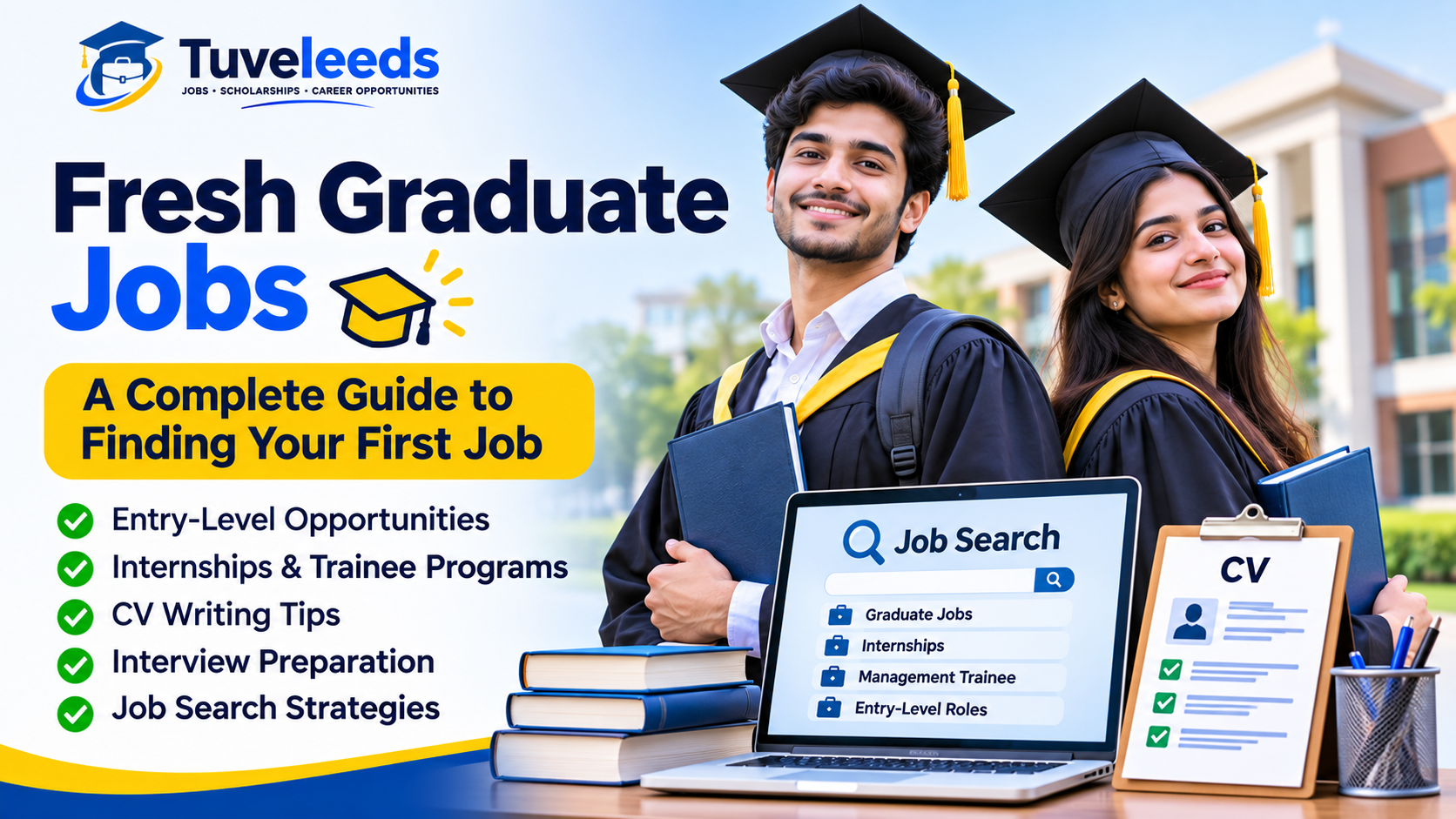
Graduating from university is an exciting milestone, but finding your first professional job can sometimes feel challenging. Many fresh graduates have academic qualifications, theoretical knowledge, and enthusiasm to work, but they may not know where to find suitable vacancies, how to prepare a professional CV, or how to perform confidently in an interview.
If you have recently completed your bachelor's degree, master's degree, diploma, or professional qualification, there are many career paths you can explore. Companies across different industries recruit fresh graduates for entry-level positions, internships, trainee programs, junior roles, and graduate development opportunities.
Whether you studied computer science, business administration, engineering, finance, marketing, healthcare, education, or another discipline, the right preparation can help you move from university life into professional employment.
This guide explains how to find fresh graduate jobs in Pakistan and internationally, where to search for entry-level opportunities, how to prepare your CV, and how to improve your chances of getting your first job.
What are fresh graduate jobs?
Fresh graduate jobs are employment opportunities designed for individuals who have recently completed their education and are beginning their professional careers.
These positions generally require little or no previous full-time work experience. Employers may focus more on educational qualifications, practical knowledge, communication skills, problem-solving abilities, and willingness to learn.
Fresh graduate opportunities can include:
- Entry-level jobs: Beginner positions that help graduates gain professional experience.
- Internships: Short-term opportunities that provide practical workplace experience.
- Graduate trainee programs: Structured programs designed to train graduates for professional responsibilities.
- Management trainee positions: Programs that prepare graduates for future management and leadership roles.
- Junior professional roles: Positions in technical, administrative, financial, and operational departments.
- Apprenticeships: Training opportunities that combine practical work with professional learning.
Some employers accept candidates immediately after graduation, while others prefer applicants who have completed an internship, professional certification, or relevant project.
Why is your first job important?
Your first job is an important step in building your professional career. It helps you understand how organizations operate, develop workplace skills, and apply the knowledge you gained during your education.
Although your first position may not offer your ideal salary or job title, it can provide valuable experience that supports your future career growth.
Some important benefits of starting your professional career include:
- Practical experience: Learn how to apply academic knowledge to real business situations.
- Professional development: Improve communication, teamwork, time management, and problem-solving skills.
- Industry exposure: Understand how companies operate and what employers expect from employees.
- Professional networking: Build relationships with colleagues, managers, recruiters, and industry professionals.
- Financial independence: Start earning an income and managing your personal expenses.
- Career advancement: Build the experience needed to qualify for more responsible positions.
Your first job does not have to define your entire career. Think of it as an opportunity to learn, improve, and discover the professional direction that suits you best.
Best job opportunities for fresh graduates
Fresh graduates can explore employment opportunities in many different industries. The right choice depends on your educational background, interests, skills, and long-term career goals.
1. Information Technology and Software Development
The technology industry offers several entry-level opportunities for graduates interested in computers, software, websites, mobile applications, and digital systems.
Common job positions include:
- Junior Software Developer
- Junior Web Developer
- Frontend Developer
- Backend Developer
- Junior Flutter Developer
- IT Support Officer
- Quality Assurance Tester
- Junior Data Analyst
- Cybersecurity Intern
- Technical Support Engineer
Graduates with degrees in Computer Science, Software Engineering, Information Technology, or related fields can explore these opportunities.
Employers may look for knowledge of programming languages, databases, software development tools, networking, and problem-solving.
If you do not have professional experience, consider building personal projects, contributing to open-source software, or completing practical training to demonstrate your abilities.
2. Business Administration and Management
Business graduates can explore opportunities in management, administration, operations, human resources, sales, and business development.
Common entry-level positions include:
- Management Trainee Officer (MTO)
- Business Development Executive
- Administrative Assistant
- Operations Assistant
- Human Resources Assistant
- Project Coordinator
- Sales Executive
- Customer Relationship Officer
These positions help graduates understand business operations, organizational structures, customer relationships, and management processes.
Strong communication, organization, teamwork, and analytical skills can be especially useful in these roles.
3. Accounting and Finance
Graduates in accounting, finance, economics, and commerce can explore opportunities in banks, financial institutions, accounting firms, and corporate finance departments.
Popular entry-level positions include:
- Junior Accountant
- Accounts Assistant
- Finance Assistant
- Audit Associate
- Banking Officer
- Accounts Payable Assistant
- Accounts Receivable Assistant
- Financial Reporting Assistant
Knowledge of accounting principles, spreadsheets, financial reporting, and accounting software can help candidates prepare for these positions.
4. Marketing and Digital Marketing
Marketing is another career area with opportunities for fresh graduates who enjoy communication, creativity, advertising, and business promotion.
Common job positions include:
- Digital Marketing Assistant
- Social Media Executive
- SEO Executive
- Content Writer
- Marketing Coordinator
- Graphic Design Assistant
- Advertising Assistant
- Brand Marketing Executive
Graduates can improve their chances by learning digital marketing, search engine optimization, content creation, social media management, and online advertising.
A small portfolio containing sample campaigns, articles, graphics, or social media projects can help demonstrate practical skills.
5. Engineering and Technical Jobs
Engineering graduates can explore opportunities in construction, manufacturing, telecommunications, energy, infrastructure, and industrial organizations.
Depending on their specialization, they may apply for positions such as:
- Graduate Engineer Trainee
- Junior Electrical Engineer
- Junior Civil Engineer
- Mechanical Engineer Trainee
- Telecommunications Engineer
- Site Engineer Assistant
- Quality Control Engineer
- Maintenance Engineer Trainee
Technical knowledge, safety awareness, project documentation, and familiarity with industry tools can help graduates become stronger candidates.
6. Healthcare and Medical Careers
Healthcare graduates can explore opportunities in hospitals, laboratories, clinics, pharmaceutical companies, and healthcare organizations.
Possible entry-level positions include:
- Medical Laboratory Assistant
- Healthcare Administrator
- Pharmacy Assistant
- Research Assistant
- Medical Records Assistant
- Public Health Assistant
- Clinical Support Staff
Some healthcare positions require professional registration, licensing, supervised training, or additional qualifications. Always check the requirements for your specific profession before applying.
7. Education and Teaching
Graduates interested in education can explore opportunities in schools, colleges, training institutes, universities, and online education platforms.
Common positions include:
- Junior School Teacher
- Teaching Assistant
- Subject Teacher
- Academic Coordinator Assistant
- Online Tutor
- Research Assistant
- Education Content Developer
Strong subject knowledge, communication skills, patience, and the ability to explain complex concepts clearly are valuable in this field.
Where to find fresh graduate jobs in Pakistan
One of the biggest challenges for fresh graduates is knowing where to search for genuine employment opportunities.
Instead of relying on a single website or social media group, use multiple job platforms, company career pages, university career offices, and professional networks.
The following websites can help you discover entry-level jobs, internships, and graduate opportunities in Pakistan.
1. Tuveleeds
Tuveleeds is a career and opportunities platform where job seekers can explore employment opportunities, scholarships, and career-related resources.
Fresh graduates can use the platform to discover relevant job opportunities, learn about career development, and access practical guidance for entering the professional world.
2. National Jobs Portal
National Jobs Portal (NJP) is an official Government of Pakistan platform for government employment opportunities.
Graduates can explore advertised vacancies, review eligibility requirements, and submit applications through the online platform.
Before applying, carefully check the required qualifications, age limits, experience requirements, and closing dates.
3. NEXT – National Employment Exchange Tool
NEXT (National Employment Exchange Tool) connects job seekers and employers through a national employment platform.
The platform provides access to government, private-sector, and overseas employment opportunities. Job seekers can create profiles, prepare their resumes, search for vacancies, and apply online.
4. LinkedIn Jobs
LinkedIn Jobs is useful for discovering opportunities posted by companies and recruitment professionals.
Fresh graduates can search for internships, graduate programs, junior positions, and entry-level vacancies.
LinkedIn also helps candidates connect with recruiters, follow companies, and build professional networks.
5. Indeed
Indeed Pakistan allows job seekers to search for vacancies using job titles, keywords, locations, and other filters.
Useful searches include "fresh graduate jobs," "entry-level jobs," "junior executive," and "graduate trainee."
6. Rozee.pk
Rozee.pk is a Pakistani employment platform where candidates can explore vacancies across different industries and locations.
Graduates can search for entry-level positions, upload their CVs, and explore opportunities that match their qualifications.
7. Company career pages
Many organizations publish vacancies directly on their official websites.
Visit the careers sections of banks, telecommunications companies, software houses, multinational companies, manufacturing organizations, and other employers.
Some companies recruit graduates through annual trainee programs, while others advertise entry-level positions throughout the year.
How to get your first job without experience
One of the most common concerns among fresh graduates is the lack of professional experience.
Many job advertisements request previous experience, even when the position is described as entry-level. This can make it difficult for graduates to understand how they are supposed to start their careers.
However, professional experience is not the only way to demonstrate your abilities.
You can strengthen your application through the following activities.
Complete internships
An internship gives you an opportunity to understand workplace responsibilities and gain practical experience.
Look for internships related to your educational background or intended career path.
Even a short internship can help you develop professional communication, teamwork, reporting, and technical skills.
Build practical projects
Personal and university projects can demonstrate your ability to apply theoretical knowledge to real-world problems.
For example, Computer Science graduates can build websites, mobile applications, or small software systems. Marketing graduates can create sample marketing campaigns, while finance graduates can prepare financial analysis projects.
Include relevant projects in your CV and explain the tools, methods, and results.
Take professional certifications
Short courses and certifications can help you develop skills that employers value.
Consider learning relevant subjects such as:
- Microsoft Excel and Microsoft Office.
- Project management fundamentals.
- Digital marketing and SEO.
- Programming and software development.
- Data analysis and visualization.
- Communication and business writing.
- Customer service and sales.
- Professional English communication.
Choose certifications that support your career goals instead of collecting certificates without developing practical skills.
Participate in volunteer activities
Volunteering can help you develop teamwork, communication, event management, leadership, and organizational skills.
University societies, nonprofit organizations, community projects, and professional events can provide opportunities to gain experience and build relationships.
Create a professional portfolio
A portfolio allows employers to review examples of your work instead of relying only on your CV.
Depending on your profession, you can include websites, applications, research papers, presentations, graphic designs, marketing campaigns, writing samples, or project reports.
How to prepare a professional CV as a fresh graduate
Your CV is often the first document an employer reviews when considering your application. A clear and professional CV can help recruiters understand your education, skills, projects, and potential.
As a fresh graduate, you may not have extensive work experience. That is why your CV should highlight your academic background, internships, practical projects, certifications, and relevant skills.
1. Add your contact information
Include your full name, professional email address, phone number, city, and LinkedIn profile if available.
Make sure your contact details are accurate so employers can reach you easily.
2. Write a professional summary
Start with a short introduction explaining your educational background, relevant skills, and career interests.
For example:
Example: "Motivated Computer Science graduate with knowledge of web development, database management, and software engineering fundamentals. Interested in applying technical skills to real-world projects while developing professional experience in a collaborative working environment."
Customize your summary for each job instead of using the same generic introduction for every application.
3. Highlight your education
Include your degree, university, graduation year, and relevant academic achievements.
If you completed an important final-year project, research assignment, or practical academic activity, consider including it in your CV.
4. Include technical and professional skills
List skills that are relevant to the position you want.
Examples include:
- Microsoft Office and Excel.
- Communication and presentation.
- Teamwork and collaboration.
- Problem-solving and analytical thinking.
- Programming languages and software tools.
- Research and documentation.
- Time management and organization.
5. Add internships and projects
If you have completed internships, university projects, freelance work, or volunteer assignments, include them in your CV.
Describe what you worked on, which responsibilities you handled, and what you achieved.
6. Include certifications and training
Add relevant professional certifications, workshops, online courses, and training programs.
Include the course provider and completion date where appropriate.
7. Keep your CV clear and professional
For most fresh graduate applications, a focused one-page CV can be effective. However, a longer CV may be appropriate when you have substantial research, project, or professional experience.
Use readable fonts, consistent formatting, clear headings, and simple language. Avoid unnecessary personal details and exaggerated claims.
How to prepare for your first job interview
Getting an interview invitation is an important achievement, but preparation is essential if you want to make a strong impression.
Employers interviewing fresh graduates generally want to understand their communication skills, motivation, knowledge, problem-solving abilities, and willingness to learn.
Here are some common interview questions and ways to approach them.
1. Tell me about yourself.
Introduce your educational background, relevant skills, academic projects, and career interests.
Keep your answer professional and focused on the position. Avoid repeating your entire CV.
2. Why should we hire you?
Explain how your qualifications, practical skills, enthusiasm, and willingness to learn can contribute to the organization.
Support your answer with examples from your studies, projects, internships, or volunteer work.
3. Why do you want to work for our company?
Research the company before the interview. Learn about its products, services, industry, and work culture.
Explain how the opportunity connects with your career goals and interests.
4. What are your strengths?
Choose strengths that are relevant to the job, such as communication, analytical thinking, teamwork, adaptability, or technical knowledge.
Give a short example that demonstrates each important strength.
5. What is your biggest weakness?
Choose a genuine area where you are improving. Explain what actions you are taking to develop that skill.
Show that you are open to learning and constructive feedback.
6. How do you handle difficult situations?
Use an example from your academic projects, internships, or group assignments. Explain the challenge, your actions, and what you learned from the experience.
7. Where do you see yourself in five years?
Discuss a realistic professional direction. Explain that you want to develop your skills, gain experience, take on greater responsibilities, and contribute to your organization.
8. Do you have any questions for us?
Prepare a few thoughtful questions about the role, training opportunities, team structure, performance expectations, and career development.
Asking relevant questions demonstrates that you are interested in understanding the position and the organization.
What is a management trainee program?
Management Trainee Officer (MTO) programs are structured development opportunities designed to prepare graduates for professional and management responsibilities.
These programs are commonly offered by banks, financial institutions, telecommunications companies, manufacturing organizations, and large corporate businesses.
During a management trainee program, participants may receive training in different business departments and learn about organizational operations.
Common training areas include:
- Business operations and administration.
- Human resource management.
- Finance and accounting.
- Marketing and sales.
- Customer relationship management.
- Project management.
- Business analysis and reporting.
Some programs include classroom training, departmental rotations, mentoring, practical assignments, and performance evaluations.
Eligibility requirements differ between employers. Some programs accept recent graduates, while others specify minimum academic grades, degree subjects, or age limits.
Always read the official advertisement carefully before applying.
Why internships are important for fresh graduates
An internship can be one of the most useful ways to move from academic learning into professional employment.
Many employers prefer candidates who understand basic workplace responsibilities, even when they are applying for junior positions.
Internships can help you:
- Gain practical industry experience.
- Understand professional communication and workplace culture.
- Develop technical and business skills.
- Build relationships with experienced professionals.
- Improve your CV.
- Understand which career path suits your interests.
- Explore potential full-time employment opportunities.
When searching for internships, consider opportunities in your field of study and focus on programs that provide meaningful training.
Do not judge an internship only by its duration or company name. Consider what you will learn and the responsibilities you will receive.
How to find remote jobs as a fresh graduate
Remote employment allows individuals to work outside a traditional office environment. Depending on the company and position, employees may work from home, a shared workspace, or another approved location.
Remote jobs can be suitable for graduates who have digital skills, good communication abilities, and access to a reliable internet connection.
Some remote-friendly entry-level positions include:
- Virtual Assistant.
- Customer Support Representative.
- Junior Content Writer.
- Social Media Assistant.
- Data Entry Operator.
- Junior Web Developer.
- Graphic Design Assistant.
- Online Research Assistant.
- Digital Marketing Assistant.
- Junior Data Analyst.
Useful platforms for exploring remote opportunities include:
Some platforms focus on freelance projects rather than traditional employment. Always check whether a vacancy is full-time, part-time, contract-based, or freelance.
Be careful of remote job advertisements that request registration fees, promise unrealistic salaries, or ask you to pay money to receive work.
Can fresh graduates apply for international jobs?
Yes. Fresh graduates can explore international employment opportunities, although eligibility depends on the destination country, employer requirements, occupation, and immigration rules.
Some international companies recruit graduates for entry-level positions, graduate development programs, internships, and junior professional roles.
However, international employers may prefer candidates who already have work authorization in their country. Other employers may consider eligible overseas applicants and provide visa sponsorship.
Before applying, consider the following:
- Check whether the vacancy accepts international applicants.
- Confirm whether the employer provides visa sponsorship.
- Review the educational and experience requirements.
- Check whether your degree or professional qualification is recognized.
- Understand the language requirements.
- Research salary, living expenses, and relocation costs.
- Verify the employer and immigration process through official sources.
Countries such as the United Kingdom, Germany, Canada, Australia, Saudi Arabia, and the United Arab Emirates have different employment and immigration pathways.
Do not assume that every entry-level vacancy provides sponsorship. Carefully review the employer's requirements and the relevant immigration rules before applying.
Skills every fresh graduate should develop
Your degree is an important qualification, but employers also look for practical abilities that help candidates perform effectively in professional environments.
Developing the following skills can improve your readiness for employment.
Communication skills
Learn how to communicate professionally through emails, meetings, presentations, and workplace discussions.
Computer literacy
Become comfortable with common workplace tools such as Microsoft Word, Excel, PowerPoint, email platforms, and online collaboration software.
Problem-solving
Develop the ability to understand problems, evaluate possible solutions, and make informed decisions.
Time management
Learn how to organize tasks, manage deadlines, prioritize responsibilities, and complete work efficiently.
Teamwork
Professional environments require employees to cooperate with colleagues, share information, accept feedback, and contribute toward common goals.
Adaptability
Be willing to learn new tools, understand changing responsibilities, and adjust to different workplace situations.
Digital and AI skills
Develop familiarity with modern digital tools, artificial intelligence applications, online research, and automation where relevant to your profession.
Technology can help improve productivity, but you should also develop the judgment needed to verify information, protect confidential data, and use digital tools responsibly.
Common mistakes fresh graduates should avoid
Many graduates make avoidable mistakes during their job search. Understanding these issues can help you use your time more effectively and present yourself professionally.
- Sending the same CV everywhere: Customize your CV to match the responsibilities and requirements of each position.
- Applying without reading the advertisement: Check the qualifications, experience, location, and application deadline before applying.
- Ignoring internships: Relevant internships can help you gain experience and build professional connections.
- Exaggerating your skills: Be honest about your abilities and be prepared to demonstrate the skills listed in your CV.
- Using an unprofessional email address: Create a simple email address that includes your name or professional identity.
- Ignoring LinkedIn: Maintain a professional profile and connect with relevant recruiters and industry professionals.
- Giving up after rejection: Treat unsuccessful applications as learning opportunities and improve your approach.
- Paying for guaranteed jobs: Be cautious of anyone demanding money in exchange for guaranteed employment or recruitment.
- Not preparing for interviews: Research the organization and practice answering common interview questions.
- Applying only to large companies: Consider small businesses, startups, local organizations, and growing companies as well.
How to create a successful job search strategy
Finding your first job requires consistency and organization. Instead of applying randomly, create a simple job search plan that helps you track applications and improve your results.
Step 1: Choose your career direction
Identify the industries and positions that match your qualifications and interests.
For example, a Business Administration graduate might focus on management trainee, HR assistant, sales executive, and operations assistant positions.
Step 2: Prepare your CV and LinkedIn profile
Create a professional CV and update your LinkedIn profile with your education, skills, projects, and career interests.
Step 3: Register on job portals
Create accounts on relevant job platforms and complete your profiles accurately.
Set up job alerts where available so you can discover suitable vacancies more efficiently.
Step 4: Apply for relevant positions
Prioritize jobs that match your qualifications and career goals. Read the advertisement carefully and submit all requested documents before the deadline.
Step 5: Build professional connections
Connect with university alumni, recruiters, former classmates, and professionals working in your preferred industry.
Networking can help you discover opportunities that may not be widely advertised.
Step 6: Prepare for interviews
Research employers, practice common interview questions, and prepare examples from your education, projects, internships, and other activities.
Step 7: Review and improve your progress
Maintain a record of the companies you applied to, application dates, interview invitations, and responses.
If you are not receiving interview invitations, review your CV and application strategy. If you are getting interviews but not receiving offers, focus on improving your interview performance.
A practical 30-day job search plan for fresh graduates
If you are unsure where to begin, the following 30-day plan can help you organize your preparation and start applying for suitable opportunities.
Week 1: Career planning and preparation
- Identify three to five job positions that match your education.
- Research the skills employers commonly request.
- Prepare a professional CV.
- Update your LinkedIn profile.
- Collect your educational certificates and relevant documents.
Week 2: Skills and professional development
- Identify gaps in your professional or technical skills.
- Complete a relevant online course or practical training activity.
- Prepare examples of university projects or personal work.
- Practice professional communication and interview answers.
- Build or improve your portfolio where relevant.
Week 3: Job searching and applications
- Register on suitable job portals.
- Search for entry-level positions and internships.
- Apply for jobs that match your qualifications.
- Follow relevant companies on LinkedIn.
- Connect with recruiters and industry professionals.
Week 4: Interviews and improvement
- Prepare for interview invitations.
- Research companies before attending interviews.
- Practice technical and general interview questions.
- Follow up professionally where appropriate.
- Review your applications and identify areas for improvement.
Remember that 30 days is a starting plan, not a guarantee of employment. Your first job may take longer, so remain consistent and continue developing your skills.
Frequently asked questions about fresh graduate jobs
Can I get a job immediately after graduation?
Yes. Many companies recruit fresh graduates for entry-level positions, internships, and trainee programs. However, the recruitment process and eligibility requirements vary between employers.
Can I get a job without experience?
Yes. Many entry-level positions are designed for candidates with little or no previous full-time work experience. You can strengthen your application by highlighting academic projects, internships, certifications, practical skills, and volunteer activities.
Which jobs are best for fresh graduates in Pakistan?
Suitable opportunities depend on your educational background and interests. Common options include management trainee positions, junior software developer roles, accounts assistant positions, marketing executives, HR assistants, customer support representatives, and graduate engineer trainee programs.
What is the best website to find fresh graduate jobs in Pakistan?
You can explore opportunities through Tuveleeds, the National Jobs Portal, NEXT, LinkedIn Jobs, Indeed Pakistan, and Rozee.pk. You should also check the official career pages of companies that interest you.
Can I apply for government jobs as a fresh graduate?
Yes. Government departments advertise positions for candidates with different educational backgrounds and experience levels. Some vacancies accept fresh graduates, while others require professional experience, specific qualifications, or other eligibility conditions.
Should I choose an internship or a full-time job?
If you receive a suitable full-time job offer, it may be a good starting point. However, an internship can be valuable when you lack practical experience or want to explore a particular industry. Consider the training, responsibilities, compensation, and future opportunities before deciding.
Can I work remotely as a fresh graduate?
Yes. Some companies offer remote entry-level positions in customer support, content writing, digital marketing, software development, design, and online research. Always verify the employer and employment conditions before accepting an offer.
Do companies hire fresh graduates without a high CGPA?
Some employers have minimum academic requirements, while others focus more on practical skills, communication, projects, and interview performance. Always review the eligibility criteria of each vacancy.
How many jobs should I apply for every week?
There is no fixed number. Focus on submitting quality applications to relevant vacancies instead of applying randomly. Maintain a consistent routine and customize your applications according to each job description.
Can fresh graduates apply for jobs abroad?
Yes. Some international employers recruit fresh graduates and overseas applicants for eligible entry-level roles and graduate programs. However, visa sponsorship and work authorization depend on the destination country's immigration rules and employer requirements.
What should I do if I cannot find a job after graduation?
Continue improving your skills, consider internships or freelance projects, expand your professional network, and review your CV. You can also explore related entry-level positions while working toward your preferred career.
Conclusion
Starting your professional career after graduation can be challenging, but it is also an opportunity to discover your strengths, develop valuable skills, and build a successful future.
You do not need to have everything figured out before applying for your first job. What matters is preparing a professional CV, understanding your career interests, developing practical skills, and consistently searching for suitable opportunities.
Explore entry-level vacancies, apply for internships, participate in professional training, and build relationships with people in your preferred industry. Even small opportunities can help you gain the experience needed for bigger career goals.
If you are a fresh graduate searching for your first professional opportunity, start exploring available vacancies today and take the next step toward your career.
Tuveleeds helps job seekers discover employment opportunities, explore scholarships, and access practical career guidance. Visit Tuveleeds regularly to explore job listings, graduate opportunities, internships, and resources that can support your professional journey.
Important disclaimer
This article is intended for general educational and career guidance purposes. Job availability, recruitment requirements, salaries, eligibility criteria, and application deadlines vary by employer and may change over time.
Always verify job advertisements through official employer websites or trusted recruitment platforms. Never provide money to unverified individuals in exchange for guaranteed employment, interviews, or job offers.